
From Conversation to Action


More than three decades behind the microphone taught me the value of listening, asking difficult questions and having honest conversations. From covering major breaking news to spending countless Monday nights following City Council, my career in radio shaped how I see Thunder Bay, its challenges and the responsibility we all share for its future.
My connection to Thunder Bay municipal politics did not begin with a campaign. It began behind a microphone, listening, asking questions and trying to understand how the decisions made at City Hall affected the people who call this city home.
My radio career started in Thunder Bay in 1990. Over more than three decades in broadcasting, I had the opportunity to work in different communities, alongside some exceptional broadcasters, and through some of the biggest stories of our time. But no matter where my career took me, radio taught me something that has stayed with me: the best broadcasting is a conversation with the people you serve.
Early in my career, I spent time on the air in New Brunswick before returning home. In 1999, I joined CBC Radio in Thunder Bay and had the privilege of working alongside legendary broadcaster Lisa Laco.
Lisa and I were together on the air on September 11, 2001.
Like broadcasters everywhere that morning, we were trying to make sense of something almost impossible to comprehend while events were unfolding in real time. There was no script for a day like that. There was no opportunity to wait until all the facts were known before going on the air. People were listening because they wanted information, but I believe they were also listening because they wanted a familiar voice helping them understand what was happening.
That day reinforced for me why local radio matters.
It taught me the importance of being honest with listeners, of admitting what you know and what you don't know, and most importantly, of being yourself. Listeners can tell when someone is simply reading words into a microphone. They can also tell when someone genuinely cares about the conversation.
That lesson shaped the rest of my career.
I never believed local radio should be afraid of difficult subjects. I never believed the role of a broadcaster was simply to tell people what happened and move on to the next story. Sometimes our job was to ask uncomfortable questions. Sometimes it was to challenge conventional thinking. Sometimes it meant giving an opinion that people strongly disagreed with.
That's okay.
A healthy community should be able to disagree. What matters is that the conversation is informed, fair and based on the facts.
Another legendary Thunder Bay broadcaster, Rick Smith, helped teach me that lesson early in my career. I worked as a council reporter on election night with Rick, and watching him work helped shape my understanding of what good local broadcasting could accomplish.
Rick understood the value of conversation. He understood that broadcasters could express opinions while still being fair. He understood the importance of holding elected officials accountable for the decisions they made.
Most importantly, he understood that when local radio did its job properly, people talked about their city.
That philosophy became increasingly important to me later in my career as I began working more closely with the newsroom and developed a much deeper interest in current events and municipal politics.
Eventually, watching Thunder Bay City Council became part of my routine.
For more than a decade, I watched virtually every council meeting. And anyone who has followed Thunder Bay City Council knows exactly what that means.
There were long nights. Very long nights.
There were debates over major infrastructure projects, budgets and tax increases. There were discussions about economic development, policing, roads, recreation, housing and the future direction of the city. There were also debates about issues such as backyard chickens that could somehow consume an extraordinary amount of council's time.
Some issues involved millions of dollars. Others involved relatively little. But they all provided a window into how municipal government works and, sometimes, how it doesn't.
Through my City Council Round Up and other on-air commentary, my goal was not simply to repeat what had happened the night before. The news could tell you that.
I wanted to talk about what those decisions meant.
I listened to council meetings as a broadcaster, but I also listened as a resident and taxpayer.
If council was considering another spending increase, I wanted to know why. If a project was going over budget, I wanted to understand how it happened. If councillors were approving something taxpayers would be paying for years into the future, I believed the public deserved to understand the consequences.
And when I thought council got something right, I said that too.
Over time, those conversations became an important part of my relationship with listeners. People would stop me in the grocery store, send messages, call the station or approach me at community events to talk about something that happened at council.
They didn't always agree with me. I didn't expect them to.
The important part was that they were paying attention.
Municipal government has an enormous impact on our everyday lives, yet it can sometimes feel distant from the people paying the bills. Property taxes, roads, sidewalks, drainage, emergency services, recreation facilities, development, infrastructure and neighbourhood services are not abstract political issues. They affect families, businesses, seniors and taxpayers every day.
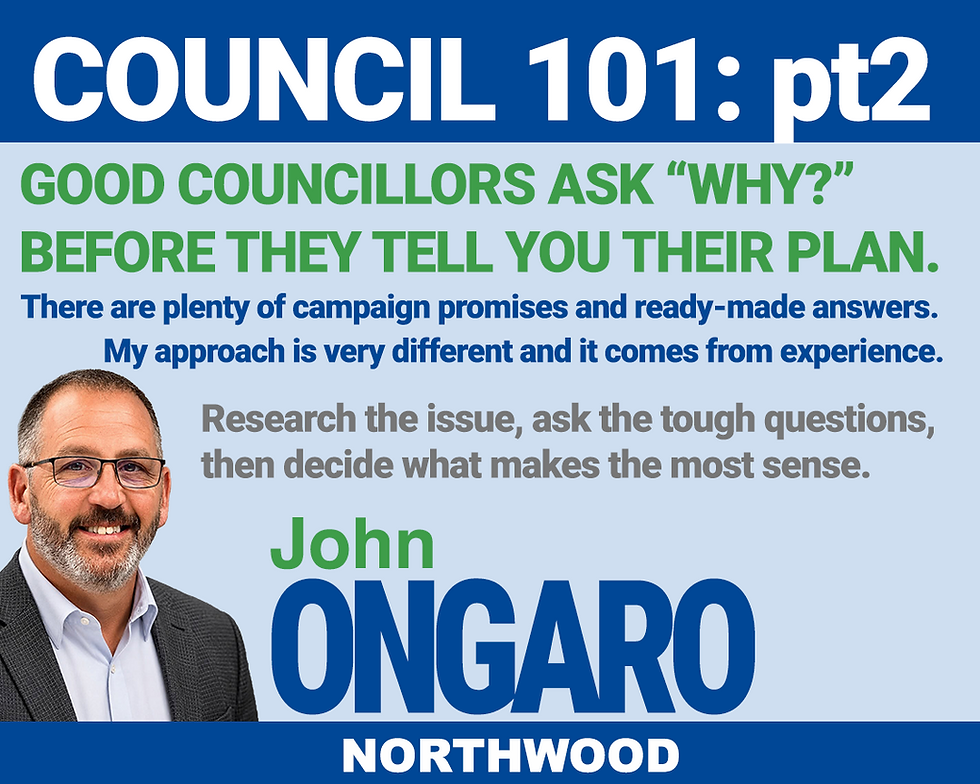
That is why I always tried to cut through the political language and ask some fairly basic questions.
Do we need it? Can we afford it? Is it a priority? Are taxpayers getting value for their money? And will this decision make Thunder Bay a better place five, ten or twenty years from now?
Those questions may sound simple, but after countless hours watching council meetings, I learned that they are not always asked often enough.
I also learned that municipal government is rarely as simple as it appears from the outside. There are competing priorities, limited resources and difficult decisions. There are reports hundreds of pages long, capital forecasts stretching years into the future and infrastructure problems that cannot be solved in a single budget cycle.
That experience gave me tremendous respect for the responsibility that comes with sitting at the council table.
It also gave me perspective.
For more than ten years, I had a front-row seat to the decisions that helped shape Thunder Bay. I watched different councils set priorities. I watched administrations bring recommendations forward. I watched projects succeed and others struggle. I watched debates over spending, taxation and infrastructure repeat themselves year after year.
And I formed opinions.
Not opinions based on a few months of campaigning, but opinions developed over years of listening, reading, questioning and talking with the people who ultimately pay for municipal government.
Thunder Bay taxpayers.
Radio gave me the opportunity to start those conversations. It gave me the ability to challenge decisions, question priorities and explain what was happening inside council chambers to people who understandably didn't have several hours on a Monday night to watch the meeting themselves.
But after decades of watching from the sidelines, I believe it is time to take that experience somewhere different.
To the council table.
I'm not running because I suddenly became interested in municipal politics. I'm running because I have spent years paying attention to it.
I know the history behind many of the issues facing this city because I watched that history happen. I heard the debates. I read the reports. I interviewed the decision-makers. I questioned the spending. I listened to residents. And week after week, year after year, I gave listeners my perspective on where I believed our city was getting it right and where we needed to do better.
The microphone taught me to listen.
The newsroom taught me to ask questions.
City Hall taught me that decisions have consequences.
And the people listening taught me that accountability matters.
For more than three decades, my job was to help start the conversation.
Now I want to help turn that conversation into action.


Comments